
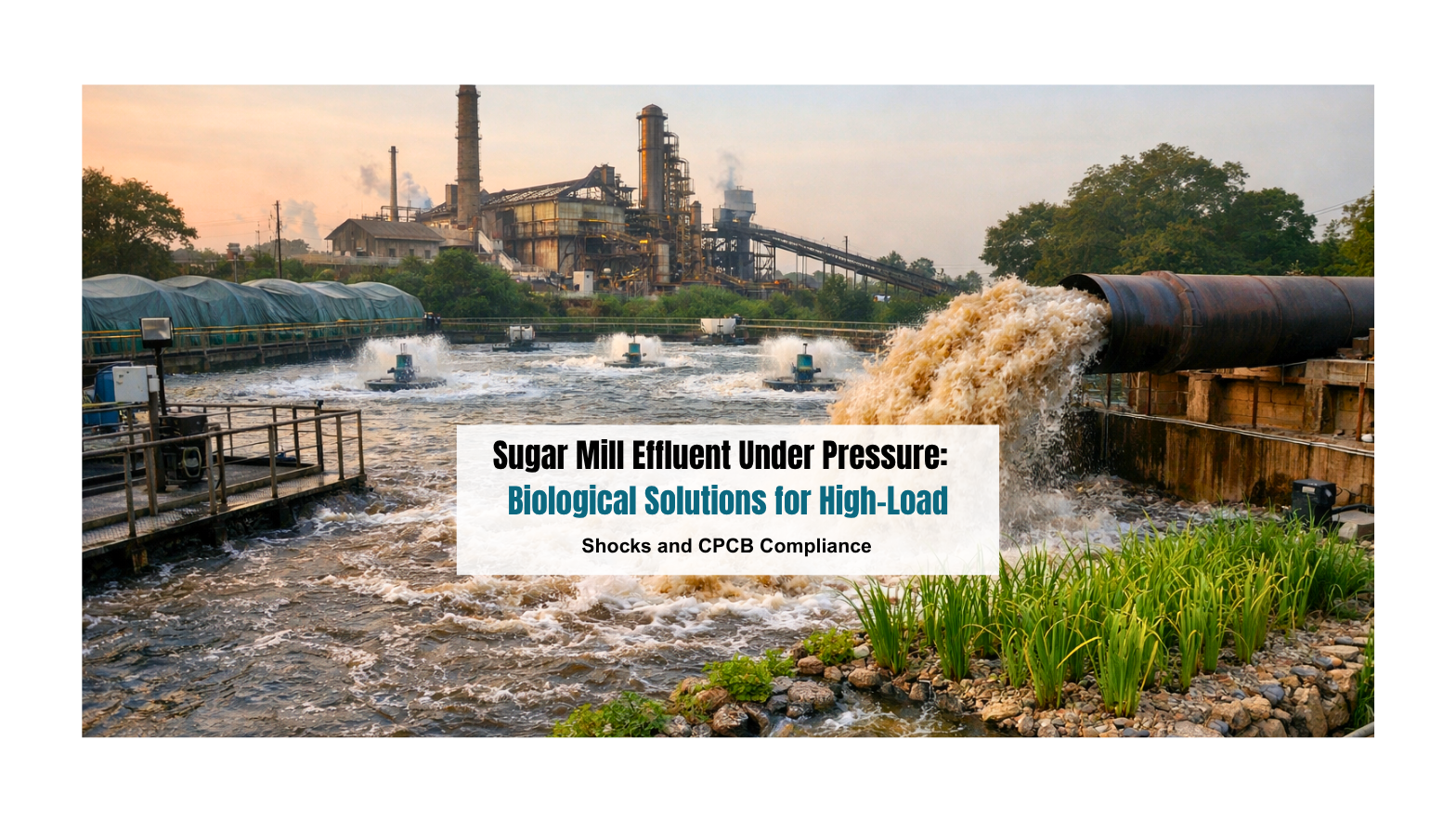

Sugar Mill Effluent Under Pressure: Biological Solutions for High-Load Shocks and CPCB Compliance
Every October, the same alarm starts ringing across sugar belt states, Uttar Pradesh, Maharashtra, Karnataka, Tamil Nadu. The cane arrives faster than any ETP was designed to absorb. Clarifier overflow. Sludge turning grey. COD spiking to levels that would make an inspector reach for his clipboard before he even finishes his chai.
For an EHS manager standing between a 24-hour production cycle and an SPCB show-cause notice, this is not a theoretical problem. This is a recurring operational crisis, one that can trigger NGT fines, plant shutdowns, and reputational damage that lingers long after the season ends.
The hidden cost of non-compliance is rarely just the penalty. It is the productivity loss during corrective shutdowns, the cost of emergency chemical dosing, the overtime hours troubleshooting a biological system that was never built for the load it is receiving. And increasingly, with CPCB tightening effluent discharge standards under the Environment Protection Act and NGT maintaining active oversight on Red Category industries, the margin for error has narrowed to almost nothing.
Biological treatment for sugar mills done right is not a backup plan. It is the foundation of a compliant, resilient sugar mill operation.
What Makes Sugar Mill Effluent a Biological Treatment Challenge
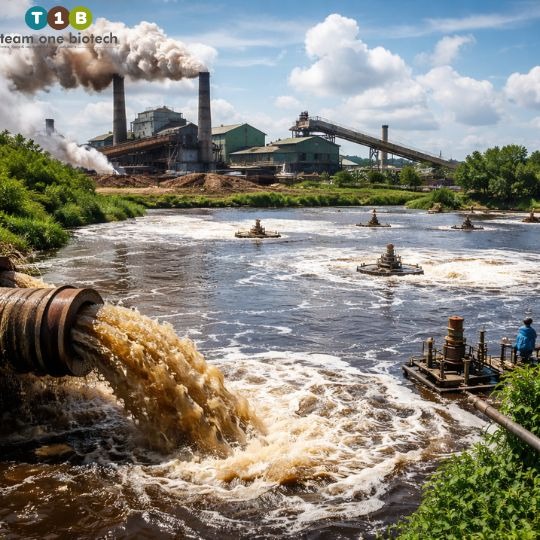
Sugar mill effluent is not ordinary wastewater. It is a concentrated, chemically complex mix that includes washings from cane preparation, barometric condenser water, juice spillage, molasses residues, and floor washdowns from the boiling house. During peak crushing, this mix arrives in volumes and concentrations that fluctuate dramatically, sometimes hour to hour.
The core parameters that drive treatment difficulty:
COD loads typically range from 2,000–15,000 mg/L depending on the unit operation and dilution, though values outside this range are documented during startup and peak throughput.
BOD values commonly fall in the 800–6,000 mg/L range in raw influent, with significant variation tied to molasses carryover and process leakages.
pH swings across 4.5–9.5 in untreated streams, driven by fermentation of residual sugars in collection channels and alkaline process water from sulphitation.
Suspended solids, including bagasse fines and soil from cane washing, regularly read between 500–3,000 mg/L in raw streams entering primary treatment.
Colour, primarily from melanoidins, the compounds formed when amino acids react with reducing sugars under heat, is one of the most persistent treatment challenges and a visible indicator of non-compliance even when COD numbers look acceptable.
All values expressed throughout this article represent general industry ranges. Actual figures vary significantly based on plant-specific machinery, cane variety, feedstock quality, process water management, and ETP/STP design configuration. Site-specific characterisation is essential before any treatment design decision.
The Science Behind Biological Degradation of Sugar Mill Wastewater
Why Microbial Consortia Outperform Chemical Treatment Alone
Chemical treatment, coagulation, flocculation, lime dosing, addresses the physical load. It does not address the dissolved organic fraction that drives your COD reading and determines whether your discharge will pass consent conditions.
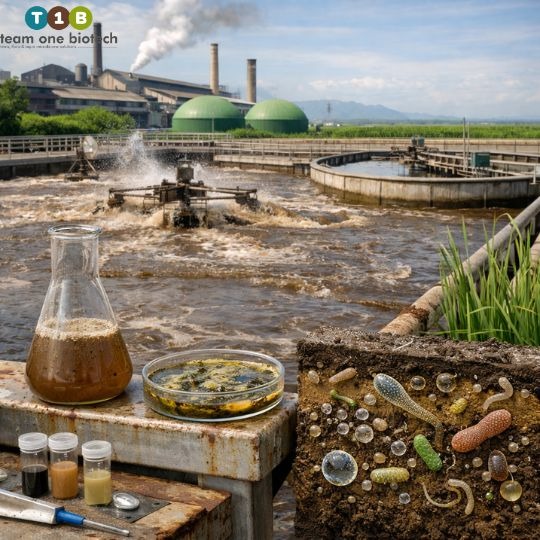
That work is done by microorganisms. Specifically, by diverse consortia of aerobic heterotrophs, facultative anaerobes, and specialised fermenters that collectively degrade the complex organic matrix of sugar mill effluent.
The primary substrates these organisms are breaking down include:
Sucrose, glucose, and fructose, rapidly consumed fermentable sugars that provide a fast-acting BOD spike in the early stages of biological treatment.
Polysaccharides and starches, from bagasse and cane pith, which require cellulolytic and amylolytic bacterial populations to hydrolyse before further degradation is possible.
Organic acids, acetic, lactic, and butyric acids formed during fermentation of residual sugars in collection sumps and anaerobic pockets of the treatment system.
Melanoidins, high-molecular-weight recalcitrant compounds requiring specialised peroxidase-producing fungi and bacteria, such as Phanerochaete-type organisms or ligninolytic populations, that many generic microbial seed cultures simply do not contain in sufficient density.
The Anaerobic-Aerobic Sequence: Getting the Biology Right
Well-designed biological treatment of sugar mill effluent typically follows a staged approach:
Anaerobic pretreatment, UASB reactors or anaerobic lagoons reduce the gross organic load, converting 55–70% of incoming COD to biogas and reducing the aerobic stage loading. COD reduction across the anaerobic stage typically falls in the 50–65% range.
Aerobic biological treatment, Extended aeration, activated sludge, or sequencing batch reactors (SBRs) handle the residual BOD and COD. Well-seeded and maintained aerobic systems achieve BOD reductions of 88–96% across the combined treatment train.
Tertiary polishing, Filtration, constructed wetlands, or advanced oxidation handles colour and residual suspended solids before ZLD or discharge.
The biology only performs at this level when the microbial population is correctly seeded, adequately fed, and protected from shock events.
Where Operations Go Wrong, The Most Common ETP Failures in Sugar Mills

Sludge Bulking and Settleability Collapse
One of the most frequently reported operational failures in sugar mill ETPs is filamentous sludge bulking, the proliferation of thread-like bacterial species that create a voluminous, poorly settling sludge blanket. This typically occurs when:
Carbon-to-nitrogen ratios are skewed by high sugar loads without proportional nitrogen supplementation. The ideal C:N:P ratio for aerobic biological treatment is approximately 100:5:1, but in sugar mill systems, this ratio can be thrown to 300:5:1 or worse during high-load periods.
Dissolved oxygen sags below 1.5–2.0 mg/L in aeration tanks during peak load, favouring filamentous organisms over floc-forming bacteria.
Hydraulic retention times are shortened during peak production to maintain inlet flow acceptance, starving the biological population of contact time.
The Failure of Generic Microbial Seeding
This is a pattern that repeats across sugar mills that are attempting biological recovery without specialist input. The plant inoculates with cow dung slurry or municipal sludge, standard practice passed down through operating teams, and then waits for the biomass to establish.
The problem is selection pressure. The microbial populations in generic seed material were never exposed to the specific substrates in sugar mill effluent, melanoidins, complex polysaccharides, high-temperature process water. Establishment is slow, COD reduction remains in the 40–60% range instead of the 85–95% range a specialist consortium can achieve, and the plant operates in a perpetual state of marginal compliance.
Monsoon-Season Biomass Instability
Monsoon creates specific problems for sugar mill ETPs in India that are rarely addressed in treatment design documents but are felt acutely by every plant operator.
Temperature drops across aerobic tanks of 8–14°C relative to pre-monsoon conditions can reduce microbial metabolic rates by 30–50%, stretching biological treatment response times and elevating discharge COD.
Stormwater ingress dilutes mixed liquor suspended solids (MLSS), the active biological mass, from stable operating ranges of 2,500–4,000 mg/L down to values below 1,000 mg/L in poorly bunded facilities.
Additionally, the crushing season in northern states begins immediately post-monsoon, meaning biomass is already stressed before it faces the season’s peak organic shock.
Regulatory Pressure and ZLD, What CPCB and NGT Are Actually Demanding

Under CPCB’s effluent standards for sugar industries and the downstream pressure from NGT judgments on critically polluted areas, many large sugar mills are now operating under consent conditions that require discharge COD below 250 mg/L, and in some states, below 150 mg/L, into inland surface water bodies.
ZLD aspirations are growing. Several state pollution control boards have begun mandating ZLD compliance for sugar mills in water-stressed districts of Maharashtra, Rajasthan, and parts of Uttar Pradesh. ZLD shifts the entire treatment objective from effluent quality to volume reduction, a target that cannot be achieved without a stable, high-performing biological treatment stage at the base of the system.
For EHS managers preparing for SPCB renewals or NGT submissions, the biological treatment performance records , MLSS logs, SV30 data, effluent quality trends, are no longer optional documentation. They are evidence.
Download Team One Biotech’s ETP Health Checklist for Sugar Mills, a field-tested audit framework covering biological performance indicators, sludge management, and CPCB compliance documentation.
The Team One Biotech Approach, Specialised Biology for Specialised Loads
Team One Biotech works with sugar mills not as a chemical supplier, but as a biological treatment partner. The difference is in the specificity of the microbial products and the depth of the technical support behind them.
The core of the approach involves:
Strain-selected microbial consortia formulated specifically for high-sucrose, melanoidin-heavy wastewater streams. These are not general-purpose cultures, they carry cellulolytic, lipolytic, and ligninolytic populations capable of degrading the recalcitrant organic fraction that generic seed material misses.
Nutrient balancing protocols that accompany every dosing plan, addressing the N:P deficiencies that are almost universal in sugar mill treatment systems.
Biomass protection strategies ahead of the crushing season, a pre-seeding programme that builds MLSS levels and microbial diversity before the high-load shock arrives, rather than attempting biological recovery in the middle of peak production.
Ongoing monitoring support across aerobic and anaerobic stages, with dosing adjustments tied to incoming load data rather than fixed schedules.
Team One Biotech’s product range spans industrial wastewater treatment, agricultural soil health, and aquaculture water quality, a breadth of biological expertise that brings cross-sector learning into every site-specific solution.
Request a site audit from Team One Biotech’s technical team, field diagnostics, effluent characterisation, and a biological treatment gap analysis built around your plant’s specific operational profile.
Moving From Firefighting to Forward Management
The sugar mill operations that achieve consistent CPCB compliance and are positioned for ZLD mandates are not necessarily those with the most capital-intensive infrastructure. They are the ones whose biological treatment is actively managed, seeded correctly at the start of the crushing season, supported through monsoon transition, monitored through the season’s peak loads, and backed by a technical partner who understands the difference between sugar mill effluent and generic industrial wastewater.
The shift from reactive crisis management to proactive biological stability is not a technology upgrade. It is an operational philosophy, supported by the right microbial science.
Sugar mill effluent treatment has a biological solution. The season does not have to be a crisis every year.
Contact Team One Biotech today for a customised microbial dosage plan built around your mill’s effluent profile, crushing schedule, and compliance targets. Treatment that works with your biology, not against your operational calendar.
Looking to improve your ETP/STP efficiency with the right bioculture?
Talk to our experts at Team One Biotech for customised microbial solutions.
Contact: +91 8855050575
Email: sales@teamonebiotech.com
Visit: www.teamonebiotech.com
Discover More on YouTube – Watch our latest insights & innovations!-
Connect with Us on LinkedIn – Stay updated with expert content & trends!